
Referencing is one of those things students think they understand. Until the marks come back. Then suddenly it matters a lot more than expected. You can write a decent essay, good ideas, fair structure, but still lose points just because the referencing style was off. Wrong commas. Wrong order. Wrong format. Small things, but they count.
This article explains APA, MLA, and Harvard referencing in a simple way. Without any heavy language, it is just a clear explanation of how they work, where they’re used, and how not to mess them up.
Why Referencing Feels Hard (And Why It Still Matters)
Referencing doesn’t feel difficult because the ideas are complex. It feels hard because the rules keep changing. One style wants dates early. Another doesn’t care about dates at all. One wants page numbers always. Another only sometimes.
Universities care about referencing because it shows two things. First, you actually used sources. Second, the work is original and not taken from someone else. It also helps the reader trace where your ideas came from. That part often gets ignored, but it matters.
Bad referencing makes good writing look careless. Good referencing makes average writing look safer.
APA Referencing: Strict and Detail Heavy
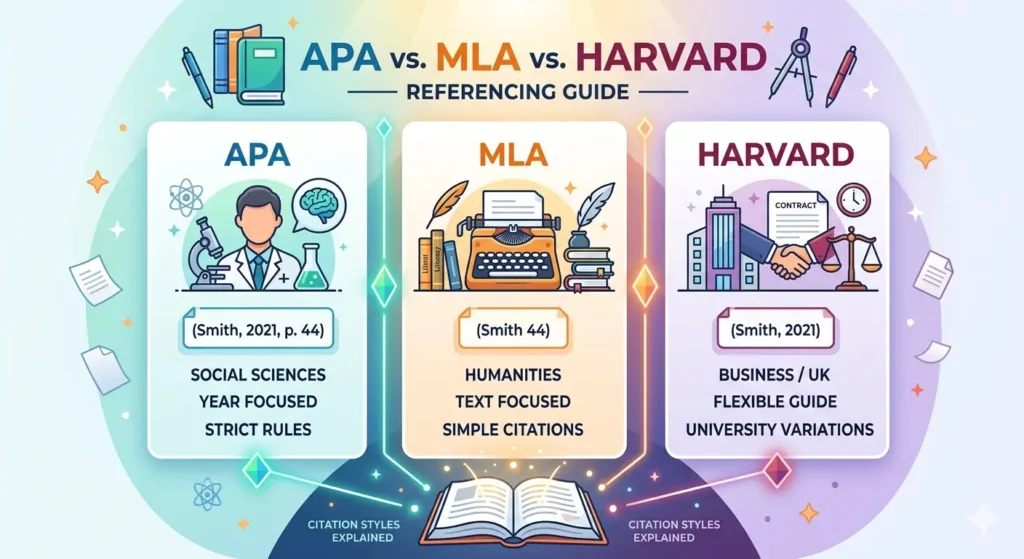
APA stands for American Psychological Association. It’s mostly used in social sciences, psychology, education, sociology, and health-related subjects as well. It’s a system that likes structure. Everything has a fixed place. Nothing is random.
In APA, the year matters a lot. Research moves fast, especially in science-based fields. Readers need to know how recent a source is right away. That’s why the date shows up almost everywhere, not just once.
In-text citations are simple but very specific. They usually look like this: (Smith, 2021)
If you use a direct quote, it becomes more detailed: (Smith, 2021, p. 44)
The reference list sits at the end. It’s called “References.” Titles are formatted carefully. Italics are required. Capitalization rules are specific. Miss one thing and the whole thing feels wrong to markers.
APA is not forgiving. You either follow it properly or you don’t. That’s why students using APA tend to double-check more, or they get help when time is low.
MLA Referencing: Built for Text and Language
MLA stands for Modern Language Association. It’s common in humanities, literature, english, media studies, and philosophy sometimes.
MLA doesn’t care much about years. It cares about text, words, and pages. Where exactly something appears in a book or article. In-text citations are short: (Smith 44) No year. Just author and page number. That’s it.
The list is called “Works Cited.” Not References. That detail matters. Titles follow a clear order. Punctuation is important. Even the placement of periods matters more than people expect.
MLA feels simpler at first. But it still trips people up, especially when there are multiple authors or online sources. It looks easy. It’s not careless-friendly.
Harvard Referencing: Flexible but Still Serious
Harvard referencing is very common in the UK, mostly in business, management, economics, law, and general academic writing.
Unlike APA or MLA, Harvard isn’t owned by one single body. That’s why small variations exist. Different universities have slightly different rules. That’s where confusion starts. Harvard uses author and year, similar to APA: (Smith, 2021). But the reference list format is different. Places, publishers, and punctuation don’t follow APA rules exactly.
Harvard feels easier because it allows for some flexibility. But that flexibility can backfire if you don’t follow your university’s version. One Harvard guide doesn’t always match another. Students often assume that all of Harvard is the same. But it’s not.
The Real Differences Between APA, MLA, and Harvard
1. In-Text Citations
- APA: Author + year
- MLA: Author + page number
- Harvard: Author + year
2. Reference Page Name
- APA: References
- MLA: Works Cited
- Harvard: Reference List
3. Focus Area
- APA: Research timeline
- MLA: Textual analysis
- Harvard: General academic clarity
4. Flexibility
- APA: Very strict
- MLA: Moderate
- Harvard: Most flexible
Mixing styles is the most common mistake. One APA-style citation inside a Harvard essay. One MLA-style reference list with APA in-text citations. That kind of mix-up is easy to spot and usually not forgiven.
Choosing the Right Referencing Style (Or Having It Chosen for You)
Most of the time, the choice isn’t yours. Sometimes the lecturer decides, the department decides, or the university decides.
If no style is mentioned, that’s when students panic. In that case, look at your subject. Humanities lean MLA. Social sciences lean APA. Business and general courses lean towards Harvard. If still unsure, ask. Guessing never ends well.
Many students also look for referencing help for assignments when deadlines stack up. Not because they don’t understand referencing at all, but because checking every comma at 2 a.m. is exhausting.
Why Referencing Becomes a Problem Near Deadlines
Referencing usually comes last after research, writing, and editing. By that point, energy is low and focus drops. Small details feel annoying instead of important.
Students rush the reference list because it looks simple. Page numbers get skipped. Italics are missed. Dates go in the wrong place. Some references are copied from random sites without checking the style at all.
Common deadline mistakes include:
- Missing page numbers for quotes
- Mixing two referencing styles by accident
- Wrong capitalization in titles
- Incomplete or broken references
This is why some students turn to a UK essay writing service at the final stage. Not always for full writing. Often just to clean things up, fix references, and reduce last-minute stress when time is almost gone.
Tools Help, But They Are Not Perfect
Citation tools are everywhere now. They feel helpful. They save time. But they are not accurate enough on their own.
Most tools struggle with details:
- They mess up italics
- They guess the capitalization wrong
- They don’t handle uncommon sources well
- They don’t know your university’s exact rules
They work fine for drafts. They help you move faster early on. But relying on them for the final submission is risky. Manual checking is still needed. Every single time.
How to Make Referencing Less Painful
The biggest fix is starting earlier than you want to. It helps more than any tool. Track sources while researching. Don’t wait until the end. Stick to one referencing style and follow it fully. Always use your university’s official guide, not a random example online.
Proofread the reference list on its own slowly. One line at a time. It’s boring, but it catches errors.
If you’re unsure about outside help, The Complete Guide to Essay Writing Services in the UK explains how these services work and what they realistically help with. It clears confusion and helps avoid wrong choices.
Referencing isn’t about looking smart. It’s about not losing easy marks at the finish line.
Final Thoughts
APA, MLA, and Harvard referencing are different systems doing the same job. They organize sources. They show honesty. They protect academic work from plagiarism issues.
APA is strict and date-focused. MLA is text-focused and cleaner. Harvard is flexible, but it depends on the institution. None of them is impossible. They just require attention.
Good referencing doesn’t make your essay brilliant. But bad referencing can quietly ruin it. That’s the part most students learn too